Take the Visibility Score
  • The Problem: False positives cost the digital economy $443 billion annuallyβ€”10x the cost of actual fraud.
  • The Risk: 40% of customers abandon a merchant permanently after a single false decline (LTV Suicide).
  • The Solution: Transitioning to a Cyber-Fraud Fusion Model to recover trapped revenue and protect enterprise valuation.
  • The Metric: Friction-Adjusted Conversion is the new North Star for the “Cyber CFO.”

Introduction: The Silent Erosion of Enterprise Value
Β 

In the battle against financial crime, most executives focus on the cost of the thief. They budget for cyber breaches, account takeovers, and wire fraud, the visible threats.
​
But the biggest hit to Gross Margin and Annual Recurring Revenue (ARR) is not the fraud you catch, or even the fraud you miss. The real threat is the legitimate customer you turn away, an invisible but direct hit to your top-line metrics.
​
Welcome to the False Positive Crisis.
​

This is not just a security issue. It is a board-level issue of financial integrity.
​
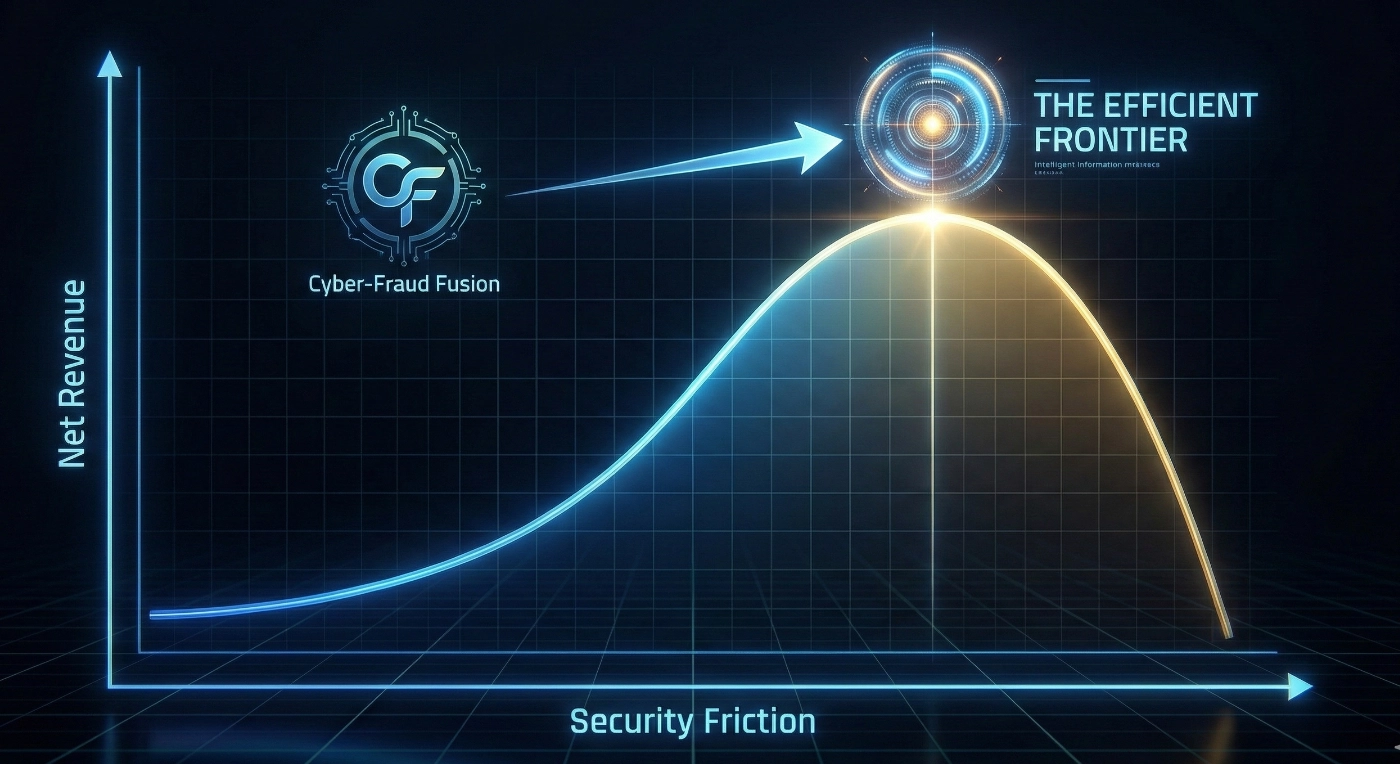
The answer is in a strategic shift: transition from a defensive cost center to a Cyber-Fraud Fusion Model that drives revenue velocity and optimizes for Friction-Adjusted Conversion.
Β 
This strategic shift is essential because it moves your organization from reactive loss prevention to proactive value creation, ensuring that fraud controls not only protect the business but also unlock new growth opportunities and enhance customer trust.
Β 
You’ll discover practical frameworks and actionable tools to diagnose where false positives are costing you the most, along with proven strategies for turning fraud prevention into a driver of revenue and loyalty.
Β 
You’ll also see how to benchmark your organization against industry leaders, deploy cross-functional solutions that break down silos, and quantify the financial upside of reducing unnecessary frictionβ€”directly addressing the pain points that hold back growth.
Β 
This is your roadmap to move beyond incremental fixes and achieve measurable, board-level results.

The Hidden Economics of False Declines (The True Cost of a “No”)
The old ‘better safe than sorry’ mindset is now a liability. What does ‘safe’ really cost? Every 1% increase in false positives can mean millions in lost revenue each year, turning caution into a recurring hit to your P&L.Β 
Β 
Traditional fraud controls, biased toward risk avoidance, rely too heavily on static rules and binary decisions. When safety means blanket prevention, you lose real opportunities and push loyal customers to competitors.Β 
​
When a legitimate transaction is incorrectly declinedβ€”a False Positiveβ€”the financial impact reverberates far beyond the initial, blocked sale.
​
To see why this shift is so urgent, we’ll start by exposing the hidden costs that most organizations overlook. You’ll discover how the financial impact of false positives can dwarf actual fraud losses.
Β 
Then, we’ll illustrate how a single false decline can erase years of hard-earned brand loyalty and customer value.
These insights are the foundation for building a smarter, more profitable approach to fraud prevention.

How does the 10:1 False Positive Ratio impact Fraud ROI?

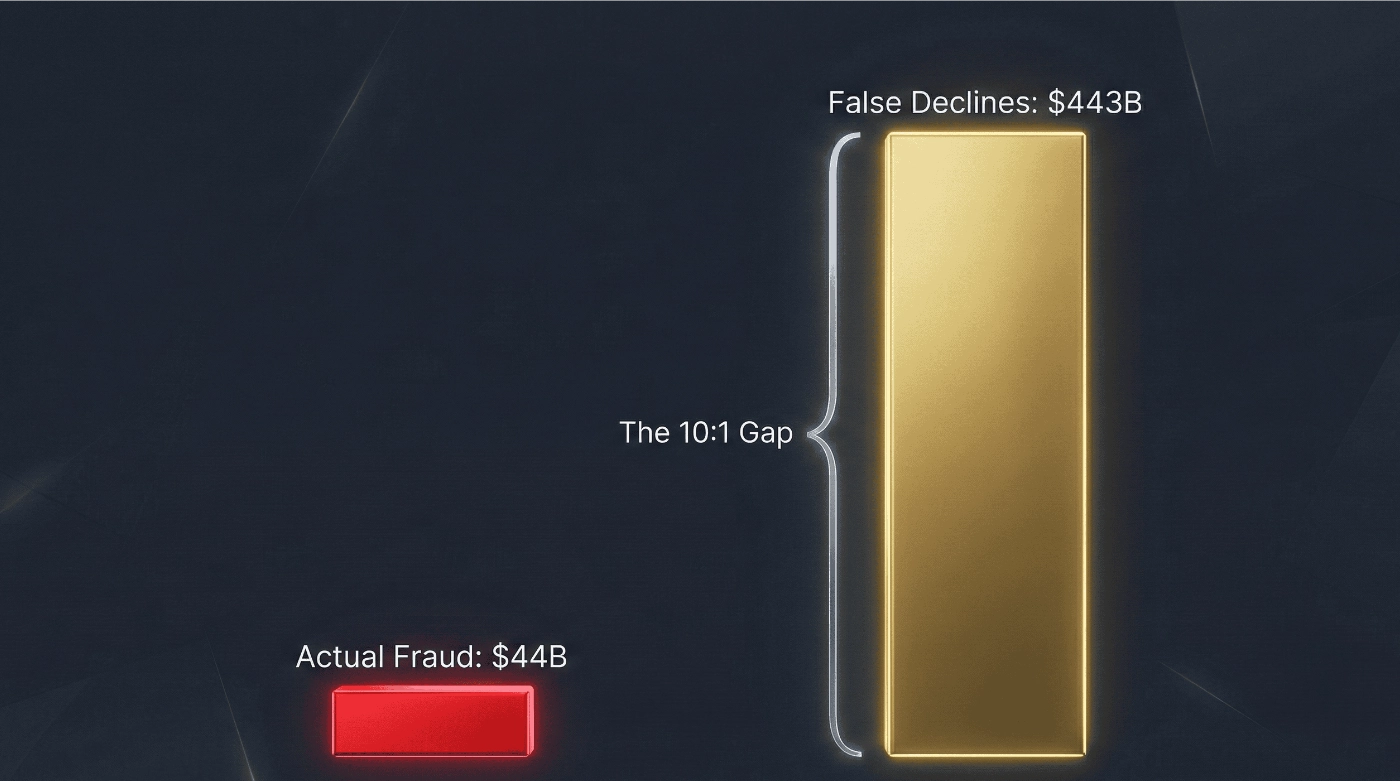
The Financial Imbalance: Merchants lose 10x more to false declines than actual fraud.

The math is as brutal as it is invisible. Merchants lose about $443 billion each year to false declinesβ€”over ten times the actual fraud loss.Β 
Β 
We protect the penny and lose the dollar.
Β 
This imbalance reveals how focusing on visible threats blinds us to the much larger financial drain caused by false positives.
​
This 10:1 ratio signals a fundamental misalignment of priorities.
Β 
Legacy systems, siloed data, and blunt rules lack the context to separate high-risk buyers from high-value customers. ​
Β 
When your risk appetite is set by blunt, binary rulesβ€””Block all transactions from X region” or “Flag all orders over $Y”β€”you aren’t just stopping thieves. You are firing your best customers.
Β 
These systems are built for basic protection, not for intelligent enablement.
Β 

What is the “Silo-Tax” in Cybersecurity and Fraud Operations?

Β 

How do disconnected Cybersecurity and Fraud teams create an intelligence gap?
Β 
The reason most organizations suffer this “Silo-Tax” is simple: Legacy systems lack contextual intelligence.
Β 
Your cybersecurity stack might see a “clean” device, while your fraud engine sees a “suspiciously large” transaction. Without a unified data layer, these signals never talk to each other.
Β 
The result? A high-value customer is treated like a criminal because your systems are built for basic protection rather than intelligent enablement.
Β 

Immediate Financial Visibility

Β 

To stop the bleed, leadership doesn’t need a months-long audit; you need a Strategic Diagnostic. The goal is to move from “we think our rates are okay” to “we know exactly where the revenue is leaking.”
Β 
By correlating your SOC (Security Operations Center) signals with your transaction decline logs, you can instantly expose where legacy silos are driving false positives. This isn’t about more work for your teamβ€”it’s about providing the C-Suite with a Friction-Adjusted Conversion dashboard.
Β 
When you fuse cyber intelligence (device health, session intent) with fraud signals (behavioural history, velocity), you stop guessing and start growing.
Β 
You move from a defensive cost center to a Velocity Engine that approves more legitimate revenue without increasing your risk profile.
​

LTV Suicide: The High Cost of “Firing” Your Best Customers

Β 

Public Insult vs. Technical Error: Why 40% of customers abandon the brand forever.

Β 

For a loyal customer, a false decline is a public insult. When a VIP who has spent years building a relationship with your brand is suddenly blocked at checkout, the relationship doesn’t just “pause.” It can end.
​
This is LTV Suicide: the systematic destruction of Customer Lifetime Value by tools that cannot tell a high-value patron from a high-risk bot.
Β 

The “Exit Interview” You Never Get

Β 

The data is uncompromising: 40% of consumers who experience a false decline will abandon a merchant entirely. They don’t call support to complain; they simply move their six-figure annual spend to a competitor whose risk engine is more intelligent and less intrusive.
Β 

The Cyber-Fraud Fusion Model: Turning Risk into a Velocity Engine

Β 

Turning to the cyber-fraud fusion model, you will see two motivators:
  • A Fiduciary Imperative: Why tool adjustments won’t solve a structural valuation drain.
  • Structural Integration: Defining the Cyber-Fraud Fusion Model.
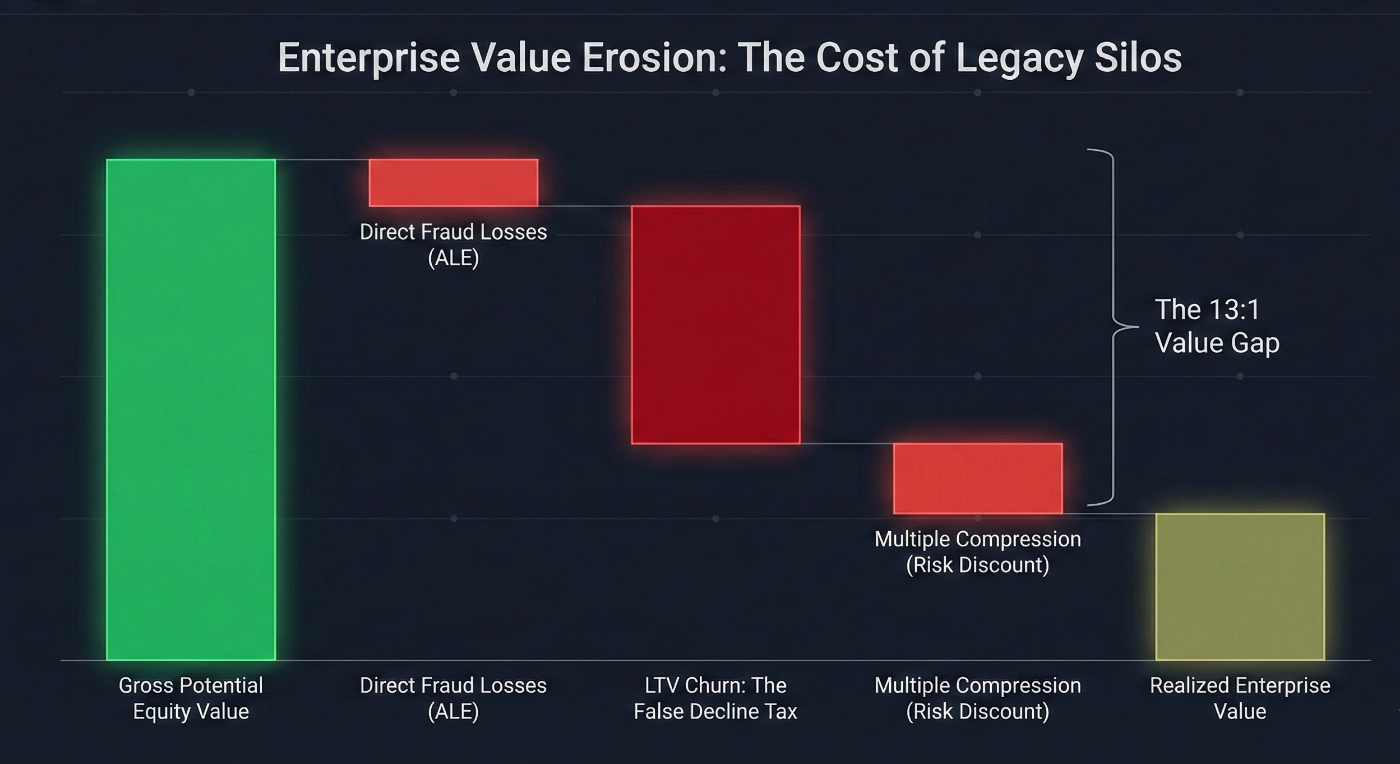
​If every false decline carries a 13:1 negative multiplier against your company’s valuation, then the status quo is no longer a “security preference”β€”it is a fiduciary risk.
Β 
You cannot solve a 13x valuation drain with incremental tool adjustments. You solve it by eliminating the structural blind spot that creates it: the gap between Cyber and Fraud.
Β 
It requires structural integration of Cyber Security and Fraud Prevention, the two functions that together provide a complete risk picture. This is the Cyber-Fraud Fusion Model.
Β 

How do you integrate SOC signals with fraud prevention to eliminate the “Silo-Tax”?

Β 
Today, most enterprises pay a hidden Silo-Tax: the measurable financial drain caused by disconnected security and fraud operations. When your Security Operations Center (SOC) identifies a technical threat (like credential stuffing) but fails to communicate that “signal” to the transaction monitoring engine, the result is either a missed breach or a blunt, high-friction decline of a legitimate customer.’
Β 

The Architecture of Intelligence Fusion

So, how do you avoid burning $13 in enterprise value for each $1 declined because your data wasn’t talking?
Β 
Eliminating the Silo-Tax requires Integrating SOC signals directly into your fraud decisioning workflow. The Cyber-Fraud Fusion Model is the bridge. It creates a unified intelligence layer that correlates technical signals and behavioural patterns in real time.
Β 
This isn’t just a data-sharing exercise; it is an architectural shift toward an Intelligence Fusion Layer.
  • Technical Signals (SOC): Monitoring for bot signatures, travel VPNs, lateral movement, and device spoofing.
  • Financial Signals (Fraud): Monitoring for account changes, transaction velocity, and beneficiary anomalies.
  • The Fusion Result: Instead of two separate “risk scores,” you generate a single, high-confidence decision. This allows you to surgically block a bot while white-gloving a VIP customer who happens to be logging in from a new device.
You stop the $1 thief with surgical precision while clearing the path for the $13 customer, who would otherwise have been blocked.

Reducing Operational Friction
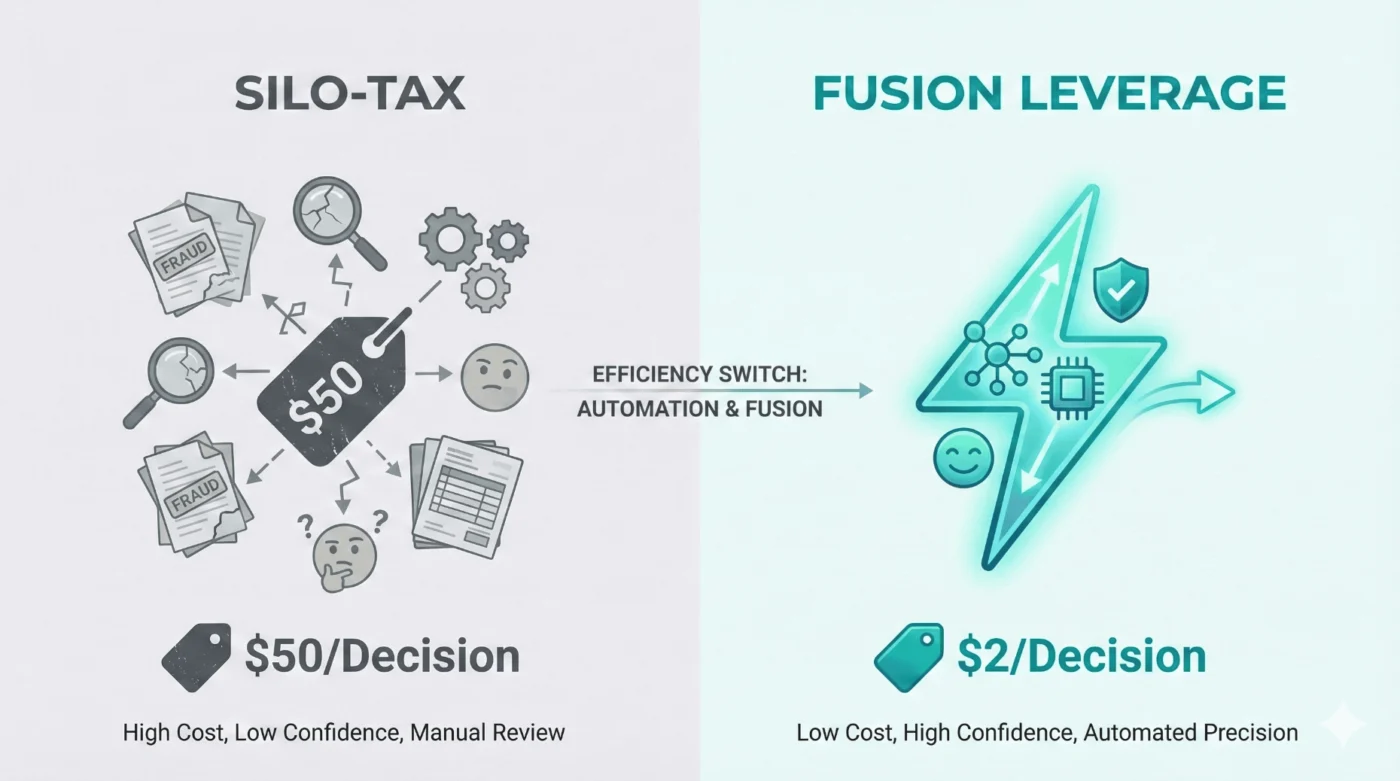
By fusing these signals, you shift from manual, siloed reviewsβ€”which can cost between $25 and $50 per alertβ€”to an automated system that reduces the Cost Per Decision (CPD) to as little as $2 to $5. This operational leverage turns your risk department from a cost-heavy gatekeeper into a high-margin Velocity Engine.
Β 

Β 

πŸ›οΈ The Compliance Imperative: OSFI B-13 and DORA

Β 

For leaders in the Canadian and European markets, the move toward a Cyber-Fraud Fusion Model isn’t just strategicβ€”it’s a regulatory hygiene requirement.
  • OSFI B-13 (Canada): The Technology and Cyber Risk Management guideline explicitly requires financial institutions to have integrated incident management. A Fusion model addresses the mandate for “timely detection and response” by ensuring that cyber-led fraud is identified before it impacts the balance sheet.
  • DORA (EU): The Digital Operational Resilience Act demands a “harmonized” approach to ICT risk. Siloed teams directly violate DORA’s spirit of holistic resilience. By unifying SOC signals with fraud monitoring, firms move from “ticking boxes” to demonstrating the Control Agility required to survive a systemic attack.
The Compliance Bonus: Beyond avoiding fines, firms that demonstrate fusion-level maturity often benefit from lower insurance premiums and a reduced Equity Risk Premium, as regulators and auditors view integrated operations as a sign of superior corporate governance.

The Business Case for the Cyber CFO: From Cost Center to Profit Accelerator

Β 
Solving the False Positive Crisis requires a fundamental shift in how we measure success. The boardroom must move beyond the False Positive Rate (FPR) and focus on a new North Star: Friction-Adjusted Conversion.
Β 
This shift allows the CISO and CRO to move from a defensive posture to an offensive one.
  • Revenue Velocity: By reducing the False Positive Rate (FPR), you capture a 5–9% increase in top-line conversion without spending a single extra dollar on marketing.
  • Operational Leverage: Moving from manual, siloed reviews (costing $25–$50 per alert) to an automated fusion system (costing $2–$5) turns your risk department into a high-margin profit center.
In an era where customer acquisition costs are skyrocketing, the Fusion Model isn’t just a “technical integration.” It is the most effective sales and marketing lever in your arsenal. It ensures that your security infrastructure doesn’t just protect the businessβ€”it scales it.
Β 

Friction-Adjusted Conversion: The New North Star

​
If False Positive Rate (FPR) drives customer churn, reducing it becomes your most effective sales and marketing lever. The boardroom should focus on a new metric: Friction-Adjusted Conversion.
Β 
This metric reflects your raw conversion rate, adjusted for the Customer Lifetime Value lost to false positives.
Β 

The Missing North Star: Friction-Adjusted Conversion (FAC) Formula

Β 

The Friction-Adjusted Conversion (FAC) metric reflects your raw conversion rate, adjusted for the Customer Lifetime Value (LTV) lost to unnecessary friction. Here is the formula:
Β 
 \text{FAC} = \left( \frac{\text{Approved Transactions} - \text{False Positives}}{\text{Total Transaction Attempts}} \right) \timesΒ  \text{LTV Index} 
  • Total Transaction Attempts: Every customer who hits the “buy” button.
  • False Positives: Legitimate customers you blocked (the $443B leak).
  • LTV Index: A weighted multiplier based on the Lifetime Value of the segment (e.g., a VIP customer has a higher index than a first-time guest).

Β 

The Strategic Logic: This metric compels the Fraud team to prioritize the “Good” customer, not just the “Bad” thief. It measures the quality of your growth, not just the volume of your blocks.
Β 
By deploying a Cyber-Fraud Fusion Model, you stop treating security as a defensive “insurance policy” and start treating it as a revenue enabler.
Β 

Unlocking Operating Leverage

Β 
This evolution enables the CISO to move from technical administrator to “Cyber CFO.” In this role, security is accountable for financial outcomes, not just uptime.
Β 
The ROI case is two-fold:
Β 

Revenue Velocity:

A sophisticated Fusion Model can dramatically reduce the FPR. The revenue impact is substantial: merchants implementing integrated fraud detection experience a 5-9% increase in top-line conversion by approving more legitimate customersβ€”revenue growth achieved without spending another dollar on marketing.Β 

Integrated detection leads to a 5–9% increase in top-line conversion by approving legitimate customers you’ve already paid to acquire.
Β 
The multiplier effect further amplifies this impact. Industry analysis reveals that every $1 in false declines results in approximately $13 in total losses, including wasted customer acquisition costs and lost customer lifetime value.
Β 
By reducing decline rates through cyber-fraud fusion, organizations capture revenue from customers they’ve already paid to acquire.

Margin Expansion:

Real-world implementations demonstrate measurable results. Integration of advanced fraud intelligence with issuer systems has achieved up to 25% reductions in false declines, translating directly to millions in recovered revenue.

Even modest improvements deliver significant returns: a 1% increase in approval rates can mean 1,000 additional approved orders per 100,000 transactions.Β 

Moving from manual, siloed reviews (costing $25–$50 per alert) to automated fusion decisions (costing $2–$5) sharply lowers your marginal cost of risk management.
Β 
With customer acquisition costs (CAC) rising, every increase in effective conversion is pure profit. Approving more legitimate customers drives sales growth without additional marketing spend.
Β 
This is the most powerful lever for revenue velocity.
Β 

Assuming the Cyber CFO Mandate: Security as a Fiduciary Lever

Β 

Organizations that position the CISO as a revenue enabler outperform competitors who still view security as purely defensive. This isn’t just an internal upgrade; it is a signal to the market that your business values both integrity and growth, allowing you to capture market share that others are accidentally “firing.”
​
The Fusion Model enables the CISO to move from technical administrator to ‘Cyber CFO.’ In this role, the CISO is accountable for financial outcomes tied to fraud prevention and revenue optimization.
Β 
The reporting line shifts from CIO or CTO to direct engagement with the CEO and close collaboration with the CFO, reflecting broader enterprise impact. The conversation moves from budget requests to investment proposals with quantifiable financial returns, empowering the CISO to lead cross-functional teams and drive governance on risk, customer experience, and top-line growth.
​
Treating fraud prevention and cybersecurity as profit accelerators allows you to capture at-risk revenue, improve retention, and move faster on strategic initiatives. Early adoption helps you seize market share and build a reputation as a trusted partner that values both security and customer experience.
Β 
To drive this transformation, C-suite leaders must act deliberately. Set clear financial KPIs for security leaders that tie directly to revenue growth, loss reduction, and margin expansion. Align executive incentives so CISOs and business owners are rewarded for reducing false positives and improving friction-adjusted conversion. Make sure the CISO is included in enterprise capital allocation decisions.
​
Key KPIs for measuring success can include:
  • Reduction in False Positive Rate (FPR): Tracking the percentage drop in good transactions incorrectly declined over a given period.
  • Increase in Friction-Adjusted Conversion: Measuring the percentage of approved transactions multiplied by their associated lifetime value, compared before and after improvements are implemented.
  • Manual Review Cost Savings: Calculating the reduction in operational spend as automated decisioning increases and unnecessary manual reviews decrease.
  • Recovered Revenue from Reduced Customer Churn: Quantifying the uplift in retained customer lifetime value attributed to fewer false declines.
When leadership gives the CISO authority, clear metrics, and cross-functional support, it accelerates cultural adoption and operational progress.
Β 

The Evolution of ROSI: From ALE to Equity Protection

Β 

Traditional ROSI formulas often fail to move the needle because they look only at the “Face Value” of avoided losses on the P&L (Income Statement). To justify a Cyber-Fraud Fusion investment, security leaders must bridge the gap between operational savings and Enterprise Value (EV) to account for the Multiple Effect.
Β 
Investing in a fused model is not just about stopping a thief; it is about protecting margins, increasing revenue velocity, and sustaining a premium valuation multiple.
Β 
This requires a three-stage mathematical progression:
Β 

1. The Risk Baseline: Annualized Loss Expectancy (ALE)

Β 
You cannot measure improvement without a baseline of current pain. We begin with the financial industry standard for quantifying risk.
Β 
 ALE = SLE \times ARO
  • SLE (Single Loss Expectancy): The total cost of one fraud incident.
  • ARO (Annualized Rate of Occurrence): How often that incident happens per year.
The Annual Loss Expectancy (ALE) quantifies the financial impact of anticipated fraud as the “Price of Inaction” on the P&L, showing the Board the expected losses without preventative measures.
​

2. The Revenue Engine: Friction-Adjusted Conversion (FAC)

Β 
ALE only looks at what the thief takes; FAC looks at what we take from ourselves.
Β 
Before calculating ROI, we must quantify the “Trapped Revenue” caused by false positives. We use Friction-Adjusted Conversion to measure the quality of our growth.
Β 
 \text{FAC} = ( \frac{\text{Approved Transactions} - \text{False Positives}}{\text{Total Transaction Attempts}} ) \times \text{LTV Index} 
Β 
This metric ensures that “Success” isn’t just stopping a thief, but protecting the high-value relationships that drive your LTV (Lifetime Value).
Β 
By applying the FAC formula, we identify “Trapped Revenue”β€”legitimate customers being blocked by the same rules intended to stop the ALE.
Β 
This provides the “Revenue Recovery” data needed for the next step.
Β 

3. The Combined Impact: Total Loss Reduction

Β 
You cannot calculate ROI without a “Total Win” number.
Β 
Now, we combine our fraud savings with our recovered revenue to find the total P&L impact. This is the “Found Money” the Fusion model generates.
Β 
 \text{Total Loss Reduction} = (\text{Fraud Losses Prevented}) + (\text{Recovered Revenue from FAC}) 
  • Fraud Losses Prevented: Direct savings from blocked cyber-fraud attacks.
  • Recovered Revenue: Sales captured by approving legitimate customers who were previously blocked.
  • Valuation Multiple: The sector-specific multiplier (e.g., 4x for Fintech, 8x for SaaS) applied in the FAC.
We combine the fraud we stopped (ALE reduction) with the revenue we saved (FAC recovery).
Β 
This is your Total Loss Reduction. This represents the total “Found Money” that moves from a projected loss to actual Gross Margin.
Β 

The Enhanced ROSI Formula (The Multiple Effect)

Β 

Total Loss Reduction is just cash; Enhanced ROSI is wealth.
Β 
Finally, we apply the Valuation Multiple to that recovered revenue. This moves the conversation from the Income Statement to the Balance Sheet.
Β 
 \text{Enhanced ROSI} = \frac{(\text{Total Loss Reduction} \times \text{Valuation Multiple}) - \text{Cost of Fusion}}{\text{Cost of Fusion}} 
​
This model moves beyond Annualized Loss Expectancy (ALE) by accounting for the ‘Multiple Effect’ on enterprise valuation.
​
We take that “Found Money” and apply the Valuation Multiple (e.g., 4x). Because the market values recurring, high-margin revenue more than a one-time savings, the Enhanced ROSI shows that a $1M recovery in FAC is a $4M increase in Enterprise Value.
​

The Fiduciary Lever: Equity Risk Premium & WACC

Β 
A higher valuation is only half the story; the other half is the Cost of Capital.
Β 
Institutional investors apply a “risk discount” to companies with volatile digital risks. Research from McKinsey and SSRN highlights that unmanaged digital friction directly harms equity value.
Β 
If two companies both generate $100M in ARR, but Company A has a siloed security stack causing a high False Positive Rate (leaking 5% of revenue and driving customer churn), and Company B utilizes a “Fused” model with predictable, optimized conversion, Company B will inherently command a higher revenue multiple.
Β 
When we prove to the market that our conversion is “Friction-Adjusted” and resilient, we reduce the Equity Risk Premiumβ€”the extra return investors demand to compensate for risk.
  • The Result: Since valuation multiples are the inverse of the Discount Rate, when you lower the Cost of Equity by even 1%, you gain an automatic expansion of your valuation multiple.
A lower Risk Premium leads to a lower Weighted Average Cost of Capital (WACC). Lower capital costs mean the company is more profitable to operate, which naturally increases the valuation multiple further.
Β 
By lowering your Weighted Average Cost of Capital (WACC) through superior risk governance, you don’t just save moneyβ€”you expand your multiple.
Β 

The 13:1 Justification

Β 
This framework explains why the true ROI of Cyber-Fraud Fusion often approaches a 13:1 ratio:
  • $1: Direct revenue protected from the thief we stopped (ALE).
  • $4: Prevention of wasted FCAC (Customer Acquisition Cost) and lost LTV.
  • $8: Market capitalization protected by applying a conservative Valuation Multiple (e.g., 2x to 4x) to that recovered revenue, i.e. the equity value we protected (Multiple + WACC advantage)
This turns the ROSI conversation from “How much did we save?” to “How much equity value did we protect?”β€”a language every CFO and Board member understands.
​

Board-Ready Metrics: Reporting on the “Velocity Engine”

​The Board does not need another security heatmap; they need to see Capital Efficiency.
Β 
They need data that allows them to compare cyber-fraud risk directly against credit, market, and operational risk. By implementing the Fusion Model, the CISO moves from reporting on “threats blocked” to reporting on “Capital Efficiency.”
Β 
Use these four board-ready metrics to align your risk strategy with enterprise growth targets:​
​
Metric What it Tells the Board The Velocity Impact
Friction-Adjusted Conversion
Net conversion minus LTV lost to friction.
Directly connects security performance to Revenue Velocity and Top-Line Growth.
The 13:1 Value Gap
Ratio of Equity Value lost vs. Fraud prevented.
Highlights the Capital Efficiency & ROI of current risk settings.
Realized Revenue Recovery
Cash saved by fused intelligence vs. blunt rules.
Rebrands the security budget as a Profit Center with Direct Margin Expansion.
Cost Per Decision (CPD)
Total OpEx per transaction approval.
Demonstrates Operational Scalability and leverage.
​

The “Cyber CFO” Summary

When you present these metrics, you are no longer asking for a budget to “stay safe.” You are presenting a Business Case for Resilience. You are showing the Board exactly how much revenue was being left on the table by siloed thinkingβ€”and exactly how much has been recovered through Intelligence Fusion.
Β 
These metrics position security as a trusted partner in capital allocation, speed up budget approval,
​

Conclusion: The New Mandate for the CISO: Cyber CFO

The new mandate has two main components:
  • The Systemic Fix: Moving beyond “security as insurance” to “security as profit.”
  • The Scalability Factor: Why this model works for both enterprise and high-growth mid-market firms.
The False Positive Blind Spot is a systemic failure caused by outdated controls and siloed thinking. For executive leaders in high-growth, digital-first enterprises, this is a critical and often-overlooked financial integrity issue. The impact is not limited to large organizations. Smaller businesses also face significant bottom-line losses from false positives.
Β 
The Fusion Model and recommendations here can be scaled for any organization, from affordable SaaS tools and modular integrations to streamlined cross-functional collaboration. By adapting these strategies, even resource-constrained businesses can recover lost revenue and build customer trust without major investments.
​
Fixing the false positive problem is not a cost. It is a direct, measurable way to grow your customer base and reduce operational waste.
Β 
It is time to move beyond treating security as insurance. Embrace Cyber-Fraud Fusion as a strategic lever for revenue growth. The mandate for the modern CISO is clear: become the Cyber CFO who turns risk mitigation into measurable business value.
Β 
Take action with this focused roadmap.

How to Implement a Cyber-Fraud Fusion Model (30-Day Roadmap)

For the “Cyber CFO,” the transition to a fusion model isn’t a multi-year IT overhaul. It is a structured sequence designed to capture “trapped revenue” and provide immediate board-level visibility.
​
Phase
Milestone
Key Deliverable
Week 1: Audit
The Trapped Revenue Baseline
Quantify the 10:1 ratio and the current False Positive Rate (FPR).
Week 2: Diagnostic
Signal Silo Mapping
Identify where SOC signals are not reaching fraud engines.
Week 3: Integration
The Intelligence Fusion Layer
Deploy middleware or unified data streams to correlate cyber & fraud events.
Week 4: Execution
Friction-Adjusted Conversion
Launch a real-time dashboard reporting on recovered equity value.
​
Following this sequence delivers early wins and sustained momentum in solving the false positive problem.

Unlock Revenue Now

πŸš€ Ready to Unlock Your Trapped Revenue?

Stop guessing your false-positive rates and start measuring the Profit of Resilience.

Most legacy systems hide the true cost of friction; our 13:1 Valuation Gap Analysis brings it into the light.

In this confidential 30-minute diagnostic, we will help you:

  • Baseline your “Silo-Tax”: Quantify the revenue leak between your SOC and Fraud monitoring.

  • Calculate your Friction-Adjusted Conversion: See how your risk posture is impacting LTV.

  • Draft your Boardroom Case: Receive a high-level summary of your recovered equity potential to share with your CFO.

Request Your Confidential Gap Analysis

Zero “rip-and-replace” required. Just clear, defensible data.

πŸ›οΈ Secure Your Fiduciary Defensibility

Is your current cyber-fraud silo a regulatory liability?

Schedule a Cyber-Fraud Fusion Readiness Review.

We’ll evaluate your alignment with DORA/OSFI B-13 standards and provide a roadmap to transition from a defensive cost center to a resilient, growth-oriented Cyber CFO model.

Book My Readiness Review

Frequently Asked Questions

While often used interchangeably, they represent different stages of failure. A False Positive is a system event where an honest user triggers a fraud flag. A False Decline is the business outcomeβ€”the actual blocking of that legitimate transaction. In short, the False Positive is the “misdiagnosis,” and the False Decline is the “unnecessary surgery” that costs you, the customer.

Traditional ROI focuses only on avoided losses. To provide a board-level case, you must use the Enhanced ROSI formula, which accounts for Recovered
Β 
Revenue and its impact on Enterprise Value (EV).
Β 
text{Enhanced ROSI}=frac{(text{Recovered Revenue} times text{Valuation Multiple})-text{Cost of Fusion}}{text{Cost of Fusion}}
Β 
By including the valuation multiple, you shift the narrative from “saving pennies” to “protecting equity.”
Implementation varies based on current data architecture and integration debt.
We follow a phased approach to ensure immediate ROI without a “rip-and-replace” overhaul:
  • Strategic Diagnostic (1 week): Quantifying your “Trapped Revenue” baseline.
  • Intelligence Fusion Design (4–6 weeks): Building the unified data layer and signal correlation.
  • Full Trust Architecture (3–6 months): Scaling integrated controls across the enterprise.
Investors apply an Equity Risk Premium to companies with volatile, unquantified digital risks. By reducing your FPR and demonstrating predictable “Friction-Adjusted Conversion,” you lower your firm’s overall risk profile. Β A lower risk premium translates directly into a lower Cost of Equity, which, in turn, reduces your Weighted Average Cost of Capital (WACC), making capital cheaper and supporting a higher valuation multiple than peers with siloed, high-friction stacks.
Yes. Fusion is an orchestration and governance strategy, not a tool replacement. It acts as an Intelligence Fusion Layer that sits above your current stack, ingesting SOC signals and transaction data to make better use of the tools you’ve already paid for. It actually helps the Control Agility process rationalize tool sprawl by identifying redundant or ineffective systems and eliminating costly redundancies.
For executives seeking to make this shift tangible, the first step is to commission a rapid audit of your current false positive rates and their financial impact across the organization.
Simultaneously, appoint a cross-functional task force comprising leaders from fraud, cybersecurity, finance, and customer experience to break down existing silos.
Β 
This team should be empowered to benchmark internal customer losses against industry averages and develop an action plan for unified fraud and cyber risk management.
Β 
By taking these immediate steps, C-suite leaders can lay the foundation for meaningful transformation and accelerate measurable results.

Research Sources & Industry References

Accessed: 2026

About the Author

Dr. Joseph Mwangoka is the Founder & Lead Consultant at BranchedFlow Inc.. He advises financial institutions and fraud leaders on cyber-fraud quantification, digital trust architecture, and AI-enabled risk governance. His work focuses on translating fraud exposure into board-level financial decision frameworks.

Disclaimer: This article is for educational purposes only and does not constitute legal, financial, or cybersecurity advice.

Leave a Reply

Your email address will not be published. Required fields are marked *